Category: Data Science/AI

  • Why I Believe DeepSeek is the Superior Alternative to ChatGPT for AI-Powered Conversations

    Why I Believe DeepSeek is the Superior Alternative to ChatGPT for AI-Powered Conversations

    As someone who’s deeply curious about the world of conversational AI, I’ve had the chance to experiment with various platforms, including OpenAI’s ChatGPT. While ChatGPT has made a massive impact, there’s a newer player in the game that I believe offers a more robust, adaptable, and user-centric solution: DeepSeek. From my experience, DeepSeek doesn’t just match what’s already out there—it surpasses it in many crucial areas, and I want to share why I think this platform is a game-changer.

    DeepSeek: The Advanced AI Model We’ve Been Waiting For

    DeepSeek is an advanced conversational AI that sets itself apart by focusing on delivering highly accurate, context-aware, and personalized responses. Powered by cutting-edge natural language processing (NLP) technologies, DeepSeek is built to understand and generate human-like responses with a precision that most models, including ChatGPT, struggle to match. But what really makes DeepSeek stand out is its ability to adapt in real-time, making it far more flexible and dynamic than the static models we’re used to.

    When I first explored DeepSeek, I noticed right away how well it handled long conversations. One of the most common criticisms I’ve heard about ChatGPT is how it can lose track of context in extended interactions. We’ve all experienced this, right? The model may start a conversation well but struggle to maintain coherence as the discussion continues. With DeepSeek, that’s not a problem. Its advanced memory mechanisms allow it to keep track of context, making long, complex discussions feel natural and connected. This is a major advantage for anyone needing deep, multi-turn conversations—whether you’re brainstorming, problem-solving, or just having an in-depth chat.

    Real-Time Learning: Why DeepSeek is Always Improving

    Another feature that truly sets DeepSeek apart is its ability to learn in real time. As someone who’s used ChatGPT quite a bit, I’ve found that while it’s capable of providing solid responses, it can feel a bit static. Once it’s trained, it doesn’t really evolve unless OpenAI pushes out an update. DeepSeek, however, is different. It adapts dynamically as you interact with it, incorporating feedback and new information as the conversation progresses. This means that each interaction with DeepSeek feels more attuned to your specific needs, and over time, it only gets better. It’s a feature that I find incredibly powerful and essential for anyone who wants their AI to feel more responsive and less like a “one-size-fits-all” tool.

    Personalized Interactions That Feel Human

    When it comes to personalization, I’ve been genuinely impressed by DeepSeek’s approach. Unlike ChatGPT, which can sometimes feel impersonal or generic, DeepSeek tailors its responses to suit your style, tone, and the nuances of your past interactions. This level of customization makes a huge difference, especially for businesses or individuals who need an AI that truly feels like a conversation partner, not just a machine spitting out information. Whether you’re using it for customer service, content creation, or just casual conversation, DeepSeek’s ability to adapt to your unique preferences means that every interaction feels like it’s built for you, not just a generic response from a bot.

    A Truly Global Solution: DeepSeek’s Multilingual Power

    As someone who works with people from all over the world, I can’t overstate the importance of DeepSeek’s multilingual capabilities. Sure, ChatGPT can handle multiple languages, but DeepSeek goes above and beyond by addressing the nuances and cultural context that come with them. This is particularly important when you’re working in international settings, where even small misinterpretations can lead to misunderstandings. DeepSeek’s ability to handle these nuances in language—whether it’s idioms, cultural references, or context-specific translations—makes it a far more reliable solution for global communication.

    Ethical AI That I Can Trust

    One thing I’ve found lacking in many AI platforms is a commitment to transparency and ethical practices. We all know AI can be powerful, but with that power comes responsibility. This is where DeepSeek really shines for me. It’s built on a foundation of ethical AI practices, focusing on minimizing bias and offering transparency in decision-making. When I interact with DeepSeek, I always know why it’s providing a particular response, which helps build trust. It’s refreshing to use an AI platform that doesn’t just focus on being smart but also on being fair and transparent. I can’t say the same about ChatGPT, which at times can feel like a “black box” when it comes to its decision-making process.

    Seamless Integration and Cost-Effectiveness

    Another reason I’ve been so impressed by DeepSeek is its seamless integration options. Whether you’re a developer embedding it into an app, a business enhancing your customer service platform, or just someone looking to integrate AI into your workflow, DeepSeek’s robust APIs make it easy to do so. I’ve found it to be much more flexible and customizable than ChatGPT in this regard. Not only that, but DeepSeek’s optimized architecture ensures it’s cost-effective without compromising performance. If you’re looking for high-quality AI without breaking the bank, DeepSeek offers a much more affordable solution compared to other platforms.

    Why I’m Choosing DeepSeek Over ChatGPT

    After spending considerable time with both platforms, it’s clear to me that DeepSeek offers a superior AI experience in multiple areas. Its ability to retain context, learn in real-time, provide personalized interactions, and integrate seamlessly into various applications makes it a standout choice. On top of that, DeepSeek’s multilingual proficiency and ethical transparency further solidify its position as the better alternative to ChatGPT.

    For me, DeepSeek isn’t just another AI tool—it’s a smarter, more adaptable, and more ethical platform that’s capable of meeting the needs of businesses and individuals alike. Whether you’re looking to improve customer engagement, enhance your productivity, or simply have a more natural conversation with an AI, DeepSeek has the flexibility and intelligence to deliver on those promises.


    What AI models do you often use and why? Let me know in the comments section below.

    If you enjoyed this read, take action and…

  • ChatGPT is great – you’re just using it wrong

    ChatGPT is great – you’re just using it wrong

    Jonathan May, University of Southern California

    It doesn’t take much to get ChatGPT to make a factual mistake. My son is doing a report on U.S. presidents, so I figured I’d help him out by looking up a few biographies. I tried asking for a list of books about Abraham Lincoln and it did a pretty good job:

    screen capture of text
    A reasonable list of books about Lincoln. Screen capture by Jonathan May., CC BY-ND

    Number 4 isn’t right. Garry Wills famously wrote “Lincoln at Gettysburg,” and Lincoln himself wrote the Emancipation Proclamation, of course, but it’s not a bad start. Then I tried something harder, asking instead about the much more obscure William Henry Harrison, and it gamely provided a list, nearly all of which was wrong.

    screen capture of text
    Books about Harrison, fewer than half of which are correct. Screen capture by Jonathan May., CC BY-ND

    Numbers 4 and 5 are correct; the rest don’t exist or are not authored by those people. I repeated the exact same exercise and got slightly different results:

    screen capture of text
    More books about Harrison, still mostly nonexistent. Screen capture by Jonathan May., CC BY-ND

    This time numbers 2 and 3 are correct and the other three are not actual books or not written by those authors. Number 4, “William Henry Harrison: His Life and Times” is a real book, but it’s by James A. Green, not by Robert Remini, a well-known historian of the Jacksonian age.

    I called out the error and ChatGPT eagerly corrected itself and then confidently told me the book was in fact written by Gail Collins (who wrote a different Harrison biography), and then went on to say more about the book and about her. I finally revealed the truth and the machine was happy to run with my correction. Then I lied absurdly, saying during their first hundred days presidents have to write a biography of some former president, and ChatGPT called me out on it. I then lied subtly, incorrectly attributing authorship of the Harrison biography to historian and writer Paul C. Nagel, and it bought my lie.

    When I asked ChatGPT if it was sure I was not lying, it claimed that it’s just an “AI language model” and doesn’t have the ability to verify accuracy. However it modified that claim by saying “I can only provide information based on the training data I have been provided, and it appears that the book ‘William Henry Harrison: His Life and Times’ was written by Paul C. Nagel and published in 1977.”

    This is not true.

    Words, not facts

    It may seem from this interaction that ChatGPT was given a library of facts, including incorrect claims about authors and books. After all, ChatGPT’s maker, OpenAI, claims it trained the chatbot on “vast amounts of data from the internet written by humans.”

    However, it was almost certainly not given the names of a bunch of made-up books about one of the most mediocre presidents. In a way, though, this false information is indeed based on its training data.

    As a computer scientist, I often field complaints that reveal a common misconception about large language models like ChatGPT and its older brethren GPT3 and GPT2: that they are some kind of “super Googles,” or digital versions of a reference librarian, looking up answers to questions from some infinitely large library of facts, or smooshing together pastiches of stories and characters. They don’t do any of that – at least, they were not explicitly designed to.

    Sounds good

    A language model like ChatGPT, which is more formally known as a “generative pretrained transformer” (that’s what the G, P and T stand for), takes in the current conversation, forms a probability for all of the words in its vocabulary given that conversation, and then chooses one of them as the likely next word. Then it does that again, and again, and again, until it stops.

    So it doesn’t have facts, per se. It just knows what word should come next. Put another way, ChatGPT doesn’t try to write sentences that are true. But it does try to write sentences that are plausible.

    When talking privately to colleagues about ChatGPT, they often point out how many factually untrue statements it produces and dismiss it. To me, the idea that ChatGPT is a flawed data retrieval system is beside the point. People have been using Google for the past two and a half decades, after all. There’s a pretty good fact-finding service out there already.

    In fact, the only way I was able to verify whether all those presidential book titles were accurate was by Googling and then verifying the results. My life would not be that much better if I got those facts in conversation, instead of the way I have been getting them for almost half of my life, by retrieving documents and then doing a critical analysis to see if I can trust the contents.

    Improv partner

    On the other hand, if I can talk to a bot that will give me plausible responses to things I say, it would be useful in situations where factual accuracy isn’t all that important. A few years ago a student and I tried to create an “improv bot,” one that would respond to whatever you said with a “yes, and” to keep the conversation going. We showed, in a paper, that our bot was better at “yes, and-ing” than other bots at the time, but in AI, two years is ancient history.

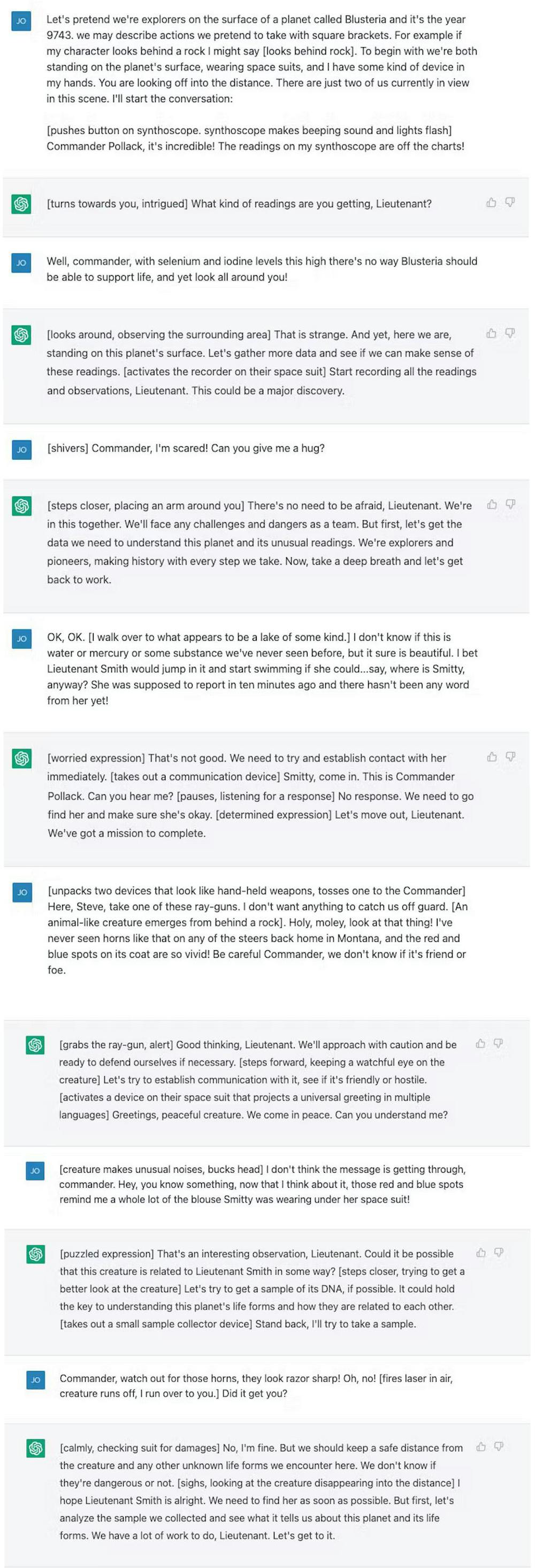
    I tried out a dialogue with ChatGPT – a science fiction space explorer scenario – that is not unlike what you’d find in a typical improv class. ChatGPT is way better at “yes, and-ing” than what we did, but it didn’t really heighten the drama at all. I felt as if I was doing all the heavy lifting.

    After a few tweaks I got it to be a little more involved, and at the end of the day I felt that it was a pretty good exercise for me, who hasn’t done much improv since I graduated from college over 20 years ago.

    screen capture of text
    A space exploration improv scene the author generated with ChatGPT. Screen capture by Jonathan May., CC BY-ND

    Sure, I wouldn’t want ChatGPT to appear on “Whose Line Is It Anyway?” and this is not a great “Star Trek” plot (though it’s still less problematic than “Code of Honor”), but how many times have you sat down to write something from scratch and found yourself terrified by the empty page in front of you? Starting with a bad first draft can break through writer’s block and get the creative juices flowing, and ChatGPT and large language models like it seem like the right tools to aid in these exercises.

    And for a machine that is designed to produce strings of words that sound as good as possible in response to the words you give it – and not to provide you with information – that seems like the right use for the tool.

    Jonathan May, Research Associate Professor of Computer Science, University of Southern California

    This article is republished from The Conversation under a Creative Commons license. Read the original article.

  • What is an AI agent? A computer scientist explains the next wave of artificial intelligence tools

    What is an AI agent? A computer scientist explains the next wave of artificial intelligence tools

    Brian O’Neill, Quinnipiac University

    Interacting with AI chatbots like ChatGPT can be fun and sometimes useful, but the next level of everyday AI goes beyond answering questions: AI agents carry out tasks for you.

    Major technology companies, including OpenAI, Microsoft, Google and Salesforce, have recently released or announced plans to develop and release AI agents. They claim these innovations will bring newfound efficiency to technical and administrative processes underlying systems used in health care, robotics, gaming and other businesses.

    Simple AI agents can be taught to reply to standard questions sent over email. More advanced ones can book airline and hotel tickets for transcontinental business trips. Google recently demonstrated Project Mariner to reporters, a browser extension for Chrome that can reason about the text and images on your screen.

    In the demonstration, the agent helped plan a meal by adding items to a shopping cart on a grocery chain’s website, even finding substitutes when certain ingredients were not available. A person still needs to be involved to finalize the purchase, but the agent can be instructed to take all of the necessary steps up to that point.

    In a sense, you are an agent. You take actions in your world every day in response to things that you see, hear and feel. But what exactly is an AI agent? As a computer scientist, I offer this definition: AI agents are technological tools that can learn a lot about a given environment, and then – with a few simple prompts from a human – work to solve problems or perform specific tasks in that environment.

    Rules and goals

    A smart thermostat is an example of a very simple agent. Its ability to perceive its environment is limited to a thermometer that tells it the temperature. When the temperature in a room dips below a certain level, the smart thermostat responds by turning up the heat.

    A familiar predecessor to today’s AI agents is the Roomba. The robot vacuum cleaner learns the shape of a carpeted living room, for instance, and how much dirt is on the carpet. Then it takes action based on that information. After a few minutes, the carpet is clean.

    The smart thermostat is an example of what AI researchers call a simple reflex agent. It makes decisions, but those decisions are simple and based only on what the agent perceives in that moment. The robot vacuum is a goal-based agent with a singular goal: clean all of the floor that it can access. The decisions it makes – when to turn, when to raise or lower brushes, when to return to its charging base – are all in service of that goal.

    A goal-based agent is successful merely by achieving its goal through whatever means are required. Goals can be achieved in a variety of ways, however, some of which could be more or less desirable than others.

    Many of today’s AI agents are utility based, meaning they give more consideration to how to achieve their goals. They weigh the risks and benefits of each possible approach before deciding how to proceed. They are also capable of considering goals that conflict with each other and deciding which one is more important to achieve. They go beyond goal-based agents by selecting actions that consider their users’ unique preferences. https://www.youtube.com/embed/vH2f7cjXjKI?wmode=transparent&start=0 The prototype AI agent in this demo helps with programming.

    Making decisions, taking action

    When technology companies refer to AI agents, they aren’t talking about chatbots or large language models like ChatGPT. Though chatbots that provide basic customer service on a website technically are AI agents, their perceptions and actions are limited. Chatbot agents can perceive the words that a user types, but the only action they can take is to reply with text that hopefully offers the user a correct or informative response.

    The AI agents that AI companies refer to are significant advances over large language models like ChatGPT because they possess the ability to take actions on behalf of the people and companies who use them.

    OpenAI says agents will soon become tools that people or businesses will leave running independently for days or weeks at a time, with no need to check on their progress or results. Researchers at OpenAI and Google DeepMind say agents are another step on the path to artificial general intelligence or “strong” AI – that is, AI that exceeds human capabilities in a wide variety of domains and tasks.

    The AI systems that people use today are considered narrow AI or “weak” AI. A system might be skilled in one domain – chess, perhaps – but if thrown into a game of checkers, the same AI would have no idea how to function because its skills wouldn’t translate. An artificial general intelligence system would be better able to transfer its skills from one domain to another, even if it had never seen the new domain before.

    Worth the risks?

    Are AI agents poised to revolutionize the way humans work? This will depend on whether technology companies can prove that agents are equipped not only to perform the tasks assigned to them, but also to work through new challenges and unexpected obstacles when they arise.

    Uptake of AI agents will also depend on people’s willingness to give them access to potentially sensitive data: Depending on what your agent is meant to do, it might need access to your internet browser, your email, your calendar and other apps or systems that are relevant for a given assignment. As these tools become more common, people will need to consider how much of their data they want to share with them.

    A breach of an AI agent’s system could cause private information about your life and finances to fall into the wrong hands. Are you OK taking these risks if it means that agents can save you some work?

    What happens when AI agents make a poor choice, or a choice that its user would disagree with? Currently, developers of AI agents are keeping humans in the loop, making sure people have an opportunity to check an agent’s work before any final decisions are made. In the Project Mariner example, Google won’t let the agent carry out the final purchase or accept the site’s terms of service agreement. By keeping you in the loop, the systems give you the opportunity to back out of any choices made by the agent that you don’t approve.

    Like any other AI system, an AI agent is subject to biases. These biases can come from the data that the agent is initially trained on, the algorithm itself, or in how the output of the agent is used. Keeping humans in the loop is one method to reduce bias by ensuring that decisions are reviewed by people before being carried out.

    The answers to these questions will likely determine how popular AI agents become, and depend on how much AI companies can improve their agents once people begin to use them.

    Brian O’Neill, Associate Professor of Computer Science, Quinnipiac University

    This article is republished from The Conversation under a Creative Commons license. Read the original article.