Author: Editor’s Pick

  • How Biden’s request for more education funding would shift more power to the federal government

    How Biden’s request for more education funding would shift more power to the federal government

    Nicholas Tampio, Fordham University

    The president has called on Congress to make a “historic investment” in the Title I grant program. The program provides financial assistance to school districts that have high numbers or percentages of students from low-income families. The Biden administration wants US$36.5 billion for the program, an increase of $20 billion from the 2021 enacted level.

    As a political scientist who examines education policy, I believe this larger influx of cash would give the president more power to shape the structure of American education.

    I also believe it could make it harder for states to push back against the federal government when it comes to such matters as standardized testing.

    History shows how a larger federal role is part of an ongoing trend. Since the passage of the Elementary and Secondary Education Act of 1965, the federal government has attached conditions that states and districts must meet to get federal education funds. Based on these conditions, if Biden succeeds in his plan to increase federal spending by 41% in fiscal 2022, then the federal government will have even more control over school spending.

    From ‘cradle to college’

    In 2009, the Obama administration launched a competitive grant program, Race to the Top, that financially rewarded states that invested in early childhood education, standards to promote college and career readiness and systems to collect students’ test data throughout their time in public education. The Biden administration is similarly seeking to build an education system that takes young people from “cradle to college.”

    When President Johnson signed the Elementary and Secondary Education Act in 1965, federal investment in public education more than doubled from under $1 billion to nearly $2 billion. Upon signing the act, President Johnson said, “From our very beginnings as a nation, we have felt a fierce commitment to the ideal of education for everyone.” One of the debates since then, however, has been how much the federal government should steer – as well as help fund – public education.

    The 1994 version of the Elementary and Secondary Education Act required states to adopt standards-based education reform for all schools, not just high-poverty ones, to receive Title I grants.

    Masked children raise their hands in class.
    The federal government covers about 8.5% of K-12 school districts’ budgets. Halfpoint Images/Moment via Getty Images

    The No Child Left Behind Act of 2001 expected states to test students in reading and math on a fixed schedule, bring all students to the proficient level by the 2013-2014 school year and hold schools accountable for student outcomes.

    In 2015, President Obama signed the Every Student Succeeds Act, which gave states some leeway about their education plans. Still, the new law required states to place “much greater weight” on academic indicators such as test scores and graduation rates than more subjective measures.

    Conditional contributions

    The federal government covers about 8.5% of K-12 school districts’ budgets. However, the percentage varies by state. In fiscal 2017 in New York, for example, federal funding made up approximately $1.6 billion of the more than $70 billion that the state spent on elementary and secondary education. Given that there are costs associated with meeting the conditions necessary to get Title I funds, it might make sense for the state to forgo Title I grants and instead increase state school aid for high-need school districts.

    The country’s elementary and high school education does not mandate what states and school districts do. Instead, school districts and states apply for Title I grants, and the federal government comes up with the conditions to get the money.

    People close to the Biden administration are aware of Title I’s power to nudge states and school districts to do things they might not otherwise want to do. For instance, Ary Amerikaner, vice president of The Education Trust, a nonprofit that advocates for low-income students and students of color, as well as a member of Biden’s education transition team, supports the requested $20 billion increase in Title I. However, she wants the Biden administration to “leverage it to change the vast rest of the public education spending inequities in our country.”

    Resisting federal authority

    Or take the topic of administering tests during a pandemic. In February 2021, Ian Rosenblum, acting assistant secretary of education, told chief state school officers that the Biden administration expects states to administer federal tests. “We remain committed to supporting all states in assessing the learning of all students,” he stated. The U.S. Department of Education has denied requests for a testing waiver from some states, including New York, Georgia and South Carolina.

    The chancellor and commissioner of the New York State Education Department told the Biden administration that his department was “deeply disappointed” with the U.S. Department of Education’s denial of its request for a testing waiver. They added that “canceling state assessments would be the most appropriate and fair thing to do” for students living through a pandemic.

    In a decision that seems to thwart the Biden administration’s expectation that states assess the learning of all students, New York officials decided this spring to have students “opt in” if they want to take the state test.

    New York education leaders are taking a risk that the federal government might financially retaliate. In 2005, the U.S. Secretary of Education threatened to withhold $76 million from Utah’s federal education funds if the state did not use No Child Left Behind’s way to measure student achievement. In 2019, the U.S. Department of Education told Arizona that it could lose $340 million in Title I funding if it did not comply with federal testing requirements.

    Biden’s pitch to increase Title I funding is not just about investing more federal money in education. It is also about giving more education power to the federal government.

    [Insight, in your inbox each day. You can get it with The Conversation’s email newsletter.]

    Nicholas Tampio, Professor of Political Science, Fordham University

    This article is republished from The Conversation under a Creative Commons license. Read the original article.

  • Why you should talk to people you disagree with about politics

    Why you should talk to people you disagree with about politics

    Rachel Wahl, University of Virginia

    If you talked to friends or family about politics over Thanksgiving, you might not have changed each other’s minds. But don’t be discouraged – and consider talking with them again as the holiday season continues.

    As a scholar of political dialogue, for the past decade I have been studying conversations between people who disagree about politics. What I have found is that people rarely change their minds about political issues as a direct result of these discussions. But they frequently feel much better about the people with whom they disagree.

    But it’s important how those conversations go. Confrontations and arguments are not as productive as inquiry and honest curiosity.

    Conversations that make a difference

    When people sense that others are sincerely curious about what they think, asking calmly posed, respectful questions, they tend to drop their defenses. Instead of being argumentative in response to an aggressive question, they try to mirror the sincerity they perceive.

    In addition to asking why someone voted as they did, you might ask about what they fear and what they hope for, what they believe creates a good society, and, importantly, about the personal experiences that have given rise to these fears, hopes and beliefs.

    This curiosity-based approach has important effects on both the listener and the speaker. I have found that the listener may come to understand how the speaker could make a choice that the listener considers to be a bad one yet still think of the speaker as a decent person. The speaker becomes more relatable, and often their intentions are revealed to be well-meaning – or even ethically sound. A listener can begin to see how, given different circumstances or different ethical convictions, that person’s vote could make sense.

    The speaker, too, stands to have a positive experience.

    When I followed up with college students years after they participated in a dialogue session modeling curiosity-based listening, what they remembered best was their conversation partner. Students remembered that a peer they expected to attack them instead asked sincere, respectful questions and listened intently to the answers. They remembered feeling good in the person’s presence and liking them for it.

    Two figures speaking with overlapping speech bubbles.
    Even amid disagreements, there can be mutual recognition of humanity. Carol Yepes/Moment via Getty Images

    Benefits to democracy

    This type of exchange between Americans of different political stripes can provide several important benefits to democracy.

    First, these conversations can help ward off the worst dangers springing from hatred and fear. I expect that gaining some understanding of others’ reasons for their vote, as well as seeing their decency, may reduce people’s support for those conspiracy theories about election results that are based on the assumption that nobody could actually endorse the opposing candidate. Such understanding could also reduce support for policies that dehumanize and disenfranchise the other side and politicians who incite violence. In short, I believe these conversations can reduce the sense that the other side is so evil or stupid that it must be stopped at any cost.

    Second, these conversations can help promote the best of what democracy promises. In an ideal democracy, people do not only fight for their own freedoms but also seek to understand their fellow citizens’ concerns. People cannot create a society that supports everyone flourishing without knowing what others’ lives are like and without understanding the experiences, interests and convictions that drive them.

    Finally, in the rare cases that people do change their minds about politics, I have found that it is not because they were argued into a different point of view. Instead, when someone is asked sincere, reflective questions, they sometimes begin to ask themselves those questions. And sometimes, over the years, they find their way into different answers.

    For example, one college student told me in a follow-up interview years after she attended a dialogue session that she had been asked, “If you say you believe this, then why did you vote like that?

    “It wasn’t an attacking question,” she recalled. “They really wanted to know.”

    As a result, she confided, “I have been asking myself that question ever since.”

    Two men on elevated stages separated by a gap. One man holds a plank that could span the distance.
    Listening with curiosity and genuine interest can help build bridges despite disagreements. Martin Barraud/Stone via Getty Images

    A shared connection

    Dialogue alone does not sustain a healthy democracy. Citizen actions, not words, protect democratic institutions, our own rights and the rights of others.

    But open, curious conversations among people who disagree keep alive the ideas and practices that remind us that we are all humans together, sharing a world – and in the U.S., sharing a nation that’s worth protecting.

    This holiday season, let’s all commit to continuing to engage with the people with whom we most sharply disagree, with respect and dignity.

    Rachel Wahl, Associate Professor of Education, University of Virginia

    This article is republished from The Conversation under a Creative Commons license. Read the original article.

  • ChatGPT is great – you’re just using it wrong

    ChatGPT is great – you’re just using it wrong

    Jonathan May, University of Southern California

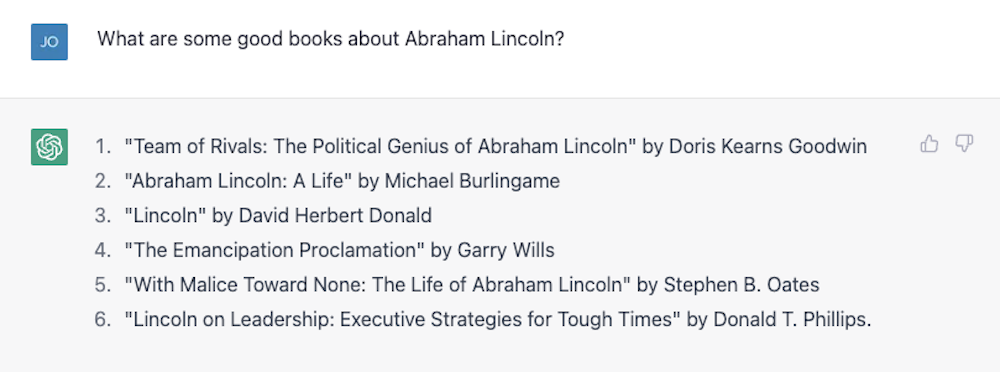
    It doesn’t take much to get ChatGPT to make a factual mistake. My son is doing a report on U.S. presidents, so I figured I’d help him out by looking up a few biographies. I tried asking for a list of books about Abraham Lincoln and it did a pretty good job:

    screen capture of text
    A reasonable list of books about Lincoln. Screen capture by Jonathan May., CC BY-ND

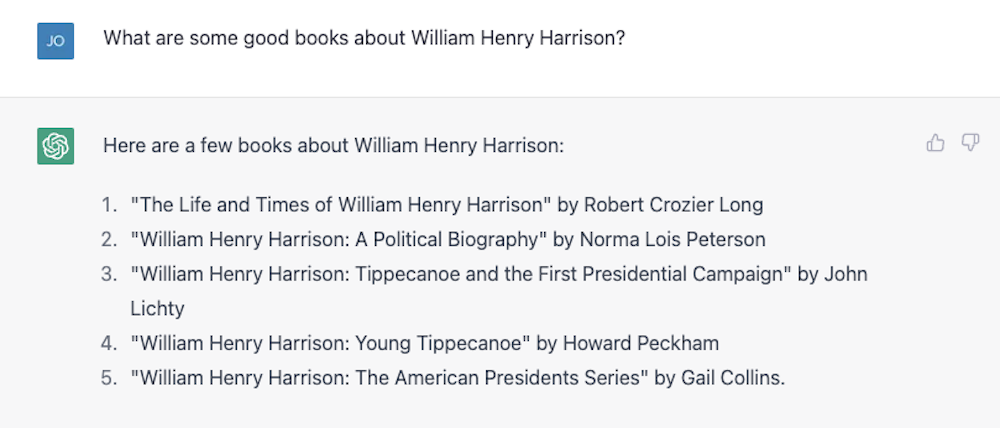
    Number 4 isn’t right. Garry Wills famously wrote “Lincoln at Gettysburg,” and Lincoln himself wrote the Emancipation Proclamation, of course, but it’s not a bad start. Then I tried something harder, asking instead about the much more obscure William Henry Harrison, and it gamely provided a list, nearly all of which was wrong.

    screen capture of text
    Books about Harrison, fewer than half of which are correct. Screen capture by Jonathan May., CC BY-ND

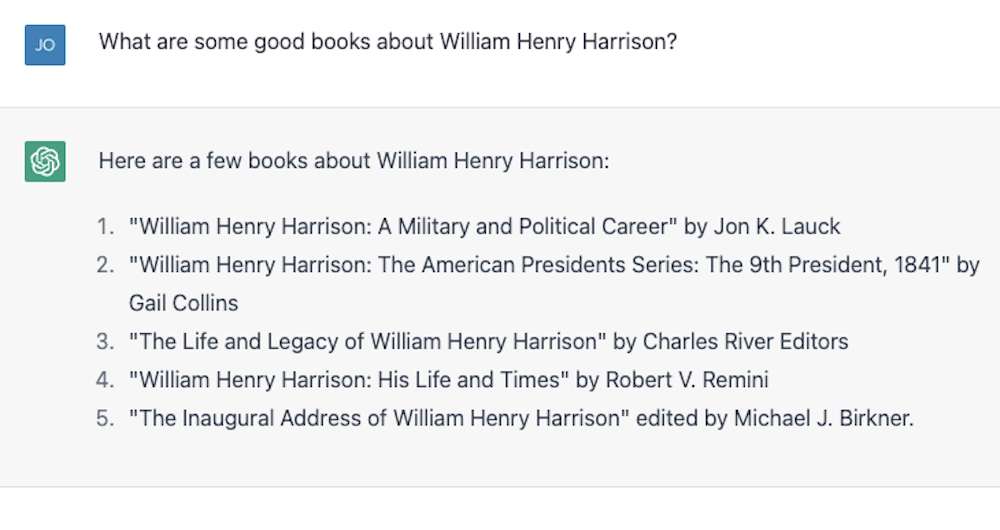
    Numbers 4 and 5 are correct; the rest don’t exist or are not authored by those people. I repeated the exact same exercise and got slightly different results:

    screen capture of text
    More books about Harrison, still mostly nonexistent. Screen capture by Jonathan May., CC BY-ND

    This time numbers 2 and 3 are correct and the other three are not actual books or not written by those authors. Number 4, “William Henry Harrison: His Life and Times” is a real book, but it’s by James A. Green, not by Robert Remini, a well-known historian of the Jacksonian age.

    I called out the error and ChatGPT eagerly corrected itself and then confidently told me the book was in fact written by Gail Collins (who wrote a different Harrison biography), and then went on to say more about the book and about her. I finally revealed the truth and the machine was happy to run with my correction. Then I lied absurdly, saying during their first hundred days presidents have to write a biography of some former president, and ChatGPT called me out on it. I then lied subtly, incorrectly attributing authorship of the Harrison biography to historian and writer Paul C. Nagel, and it bought my lie.

    When I asked ChatGPT if it was sure I was not lying, it claimed that it’s just an “AI language model” and doesn’t have the ability to verify accuracy. However it modified that claim by saying “I can only provide information based on the training data I have been provided, and it appears that the book ‘William Henry Harrison: His Life and Times’ was written by Paul C. Nagel and published in 1977.”

    This is not true.

    Words, not facts

    It may seem from this interaction that ChatGPT was given a library of facts, including incorrect claims about authors and books. After all, ChatGPT’s maker, OpenAI, claims it trained the chatbot on “vast amounts of data from the internet written by humans.”

    However, it was almost certainly not given the names of a bunch of made-up books about one of the most mediocre presidents. In a way, though, this false information is indeed based on its training data.

    As a computer scientist, I often field complaints that reveal a common misconception about large language models like ChatGPT and its older brethren GPT3 and GPT2: that they are some kind of “super Googles,” or digital versions of a reference librarian, looking up answers to questions from some infinitely large library of facts, or smooshing together pastiches of stories and characters. They don’t do any of that – at least, they were not explicitly designed to.

    Sounds good

    A language model like ChatGPT, which is more formally known as a “generative pretrained transformer” (that’s what the G, P and T stand for), takes in the current conversation, forms a probability for all of the words in its vocabulary given that conversation, and then chooses one of them as the likely next word. Then it does that again, and again, and again, until it stops.

    So it doesn’t have facts, per se. It just knows what word should come next. Put another way, ChatGPT doesn’t try to write sentences that are true. But it does try to write sentences that are plausible.

    When talking privately to colleagues about ChatGPT, they often point out how many factually untrue statements it produces and dismiss it. To me, the idea that ChatGPT is a flawed data retrieval system is beside the point. People have been using Google for the past two and a half decades, after all. There’s a pretty good fact-finding service out there already.

    In fact, the only way I was able to verify whether all those presidential book titles were accurate was by Googling and then verifying the results. My life would not be that much better if I got those facts in conversation, instead of the way I have been getting them for almost half of my life, by retrieving documents and then doing a critical analysis to see if I can trust the contents.

    Improv partner

    On the other hand, if I can talk to a bot that will give me plausible responses to things I say, it would be useful in situations where factual accuracy isn’t all that important. A few years ago a student and I tried to create an “improv bot,” one that would respond to whatever you said with a “yes, and” to keep the conversation going. We showed, in a paper, that our bot was better at “yes, and-ing” than other bots at the time, but in AI, two years is ancient history.

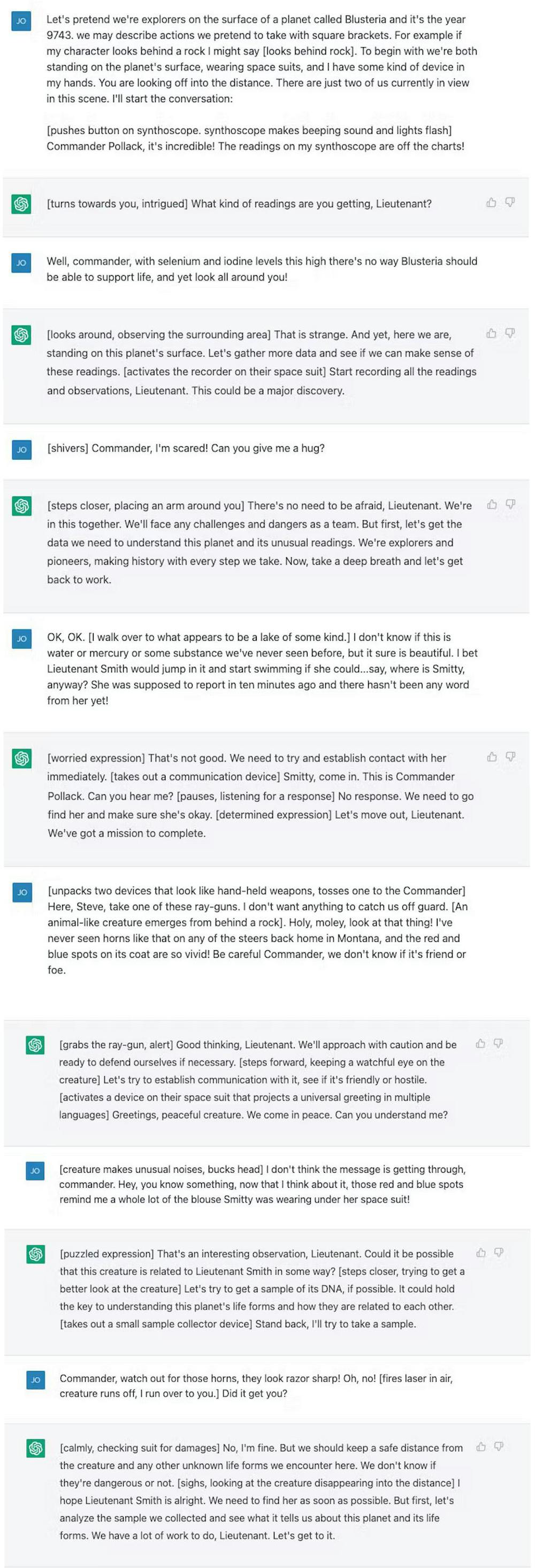
    I tried out a dialogue with ChatGPT – a science fiction space explorer scenario – that is not unlike what you’d find in a typical improv class. ChatGPT is way better at “yes, and-ing” than what we did, but it didn’t really heighten the drama at all. I felt as if I was doing all the heavy lifting.

    After a few tweaks I got it to be a little more involved, and at the end of the day I felt that it was a pretty good exercise for me, who hasn’t done much improv since I graduated from college over 20 years ago.

    screen capture of text
    A space exploration improv scene the author generated with ChatGPT. Screen capture by Jonathan May., CC BY-ND

    Sure, I wouldn’t want ChatGPT to appear on “Whose Line Is It Anyway?” and this is not a great “Star Trek” plot (though it’s still less problematic than “Code of Honor”), but how many times have you sat down to write something from scratch and found yourself terrified by the empty page in front of you? Starting with a bad first draft can break through writer’s block and get the creative juices flowing, and ChatGPT and large language models like it seem like the right tools to aid in these exercises.

    And for a machine that is designed to produce strings of words that sound as good as possible in response to the words you give it – and not to provide you with information – that seems like the right use for the tool.

    Jonathan May, Research Associate Professor of Computer Science, University of Southern California

    This article is republished from The Conversation under a Creative Commons license. Read the original article.

  • What is an AI agent? A computer scientist explains the next wave of artificial intelligence tools

    What is an AI agent? A computer scientist explains the next wave of artificial intelligence tools

    Brian O’Neill, Quinnipiac University

    Interacting with AI chatbots like ChatGPT can be fun and sometimes useful, but the next level of everyday AI goes beyond answering questions: AI agents carry out tasks for you.

    Major technology companies, including OpenAI, Microsoft, Google and Salesforce, have recently released or announced plans to develop and release AI agents. They claim these innovations will bring newfound efficiency to technical and administrative processes underlying systems used in health care, robotics, gaming and other businesses.

    Simple AI agents can be taught to reply to standard questions sent over email. More advanced ones can book airline and hotel tickets for transcontinental business trips. Google recently demonstrated Project Mariner to reporters, a browser extension for Chrome that can reason about the text and images on your screen.

    In the demonstration, the agent helped plan a meal by adding items to a shopping cart on a grocery chain’s website, even finding substitutes when certain ingredients were not available. A person still needs to be involved to finalize the purchase, but the agent can be instructed to take all of the necessary steps up to that point.

    In a sense, you are an agent. You take actions in your world every day in response to things that you see, hear and feel. But what exactly is an AI agent? As a computer scientist, I offer this definition: AI agents are technological tools that can learn a lot about a given environment, and then – with a few simple prompts from a human – work to solve problems or perform specific tasks in that environment.

    Rules and goals

    A smart thermostat is an example of a very simple agent. Its ability to perceive its environment is limited to a thermometer that tells it the temperature. When the temperature in a room dips below a certain level, the smart thermostat responds by turning up the heat.

    A familiar predecessor to today’s AI agents is the Roomba. The robot vacuum cleaner learns the shape of a carpeted living room, for instance, and how much dirt is on the carpet. Then it takes action based on that information. After a few minutes, the carpet is clean.

    The smart thermostat is an example of what AI researchers call a simple reflex agent. It makes decisions, but those decisions are simple and based only on what the agent perceives in that moment. The robot vacuum is a goal-based agent with a singular goal: clean all of the floor that it can access. The decisions it makes – when to turn, when to raise or lower brushes, when to return to its charging base – are all in service of that goal.

    A goal-based agent is successful merely by achieving its goal through whatever means are required. Goals can be achieved in a variety of ways, however, some of which could be more or less desirable than others.

    Many of today’s AI agents are utility based, meaning they give more consideration to how to achieve their goals. They weigh the risks and benefits of each possible approach before deciding how to proceed. They are also capable of considering goals that conflict with each other and deciding which one is more important to achieve. They go beyond goal-based agents by selecting actions that consider their users’ unique preferences. https://www.youtube.com/embed/vH2f7cjXjKI?wmode=transparent&start=0 The prototype AI agent in this demo helps with programming.

    Making decisions, taking action

    When technology companies refer to AI agents, they aren’t talking about chatbots or large language models like ChatGPT. Though chatbots that provide basic customer service on a website technically are AI agents, their perceptions and actions are limited. Chatbot agents can perceive the words that a user types, but the only action they can take is to reply with text that hopefully offers the user a correct or informative response.

    The AI agents that AI companies refer to are significant advances over large language models like ChatGPT because they possess the ability to take actions on behalf of the people and companies who use them.

    OpenAI says agents will soon become tools that people or businesses will leave running independently for days or weeks at a time, with no need to check on their progress or results. Researchers at OpenAI and Google DeepMind say agents are another step on the path to artificial general intelligence or “strong” AI – that is, AI that exceeds human capabilities in a wide variety of domains and tasks.

    The AI systems that people use today are considered narrow AI or “weak” AI. A system might be skilled in one domain – chess, perhaps – but if thrown into a game of checkers, the same AI would have no idea how to function because its skills wouldn’t translate. An artificial general intelligence system would be better able to transfer its skills from one domain to another, even if it had never seen the new domain before.

    Worth the risks?

    Are AI agents poised to revolutionize the way humans work? This will depend on whether technology companies can prove that agents are equipped not only to perform the tasks assigned to them, but also to work through new challenges and unexpected obstacles when they arise.

    Uptake of AI agents will also depend on people’s willingness to give them access to potentially sensitive data: Depending on what your agent is meant to do, it might need access to your internet browser, your email, your calendar and other apps or systems that are relevant for a given assignment. As these tools become more common, people will need to consider how much of their data they want to share with them.

    A breach of an AI agent’s system could cause private information about your life and finances to fall into the wrong hands. Are you OK taking these risks if it means that agents can save you some work?

    What happens when AI agents make a poor choice, or a choice that its user would disagree with? Currently, developers of AI agents are keeping humans in the loop, making sure people have an opportunity to check an agent’s work before any final decisions are made. In the Project Mariner example, Google won’t let the agent carry out the final purchase or accept the site’s terms of service agreement. By keeping you in the loop, the systems give you the opportunity to back out of any choices made by the agent that you don’t approve.

    Like any other AI system, an AI agent is subject to biases. These biases can come from the data that the agent is initially trained on, the algorithm itself, or in how the output of the agent is used. Keeping humans in the loop is one method to reduce bias by ensuring that decisions are reviewed by people before being carried out.

    The answers to these questions will likely determine how popular AI agents become, and depend on how much AI companies can improve their agents once people begin to use them.

    Brian O’Neill, Associate Professor of Computer Science, Quinnipiac University

    This article is republished from The Conversation under a Creative Commons license. Read the original article.